Stuff. Blogger tarafından desteklenmektedir.
Stability etiketine sahip kayıtlar gösteriliyor. Tüm kayıtları göster
0
Stability Ball Shoulder (Glute) Bridge |
Step 1

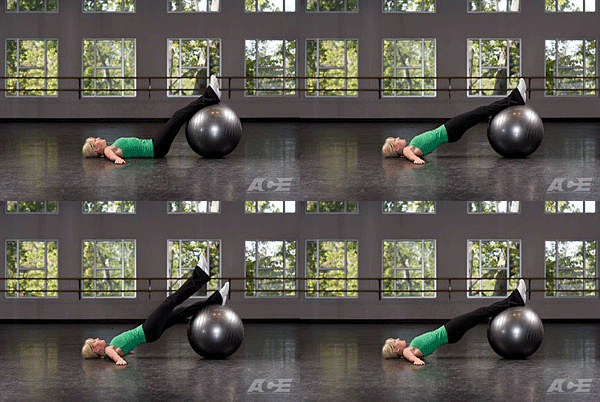
Starting Position: Lie on your back on a mat, placing the backs of your lower legs and heels on the top of a stability ball. Place your feet a few inches apart on the ball with your ankles slightly flexed. Gently use your abdominal/core muscles to press your low back into the floor. Attempt to maintain this gentle muscle contraction throughout the exercise. Your arms are out to your sides with the palms turned down to the floor to help stabilize your body during the exercise.

Step 2

Upward Phase: Gently exhale. Keep the abdominals engaged and lift your hips up off the floor. The backs of your lower legs and heels are pressing into the ball to assist the movement and provide additional stability. Press up until your torso and legs form a straight line with each other. Avoid pushing your hips so high that your low back begins to arch. Maintaining your abdominal contraction helps prevent excessive arching in your low back.

Step 3

Lowering Phase: Inhale and slowly lower yourself back towards your starting position.

Step 4

Exercise Variation (1): To further increase the balance challenge, move your feet closer together on the stability ball.

Step 5

Exercise Variation (2): To further increase the balance challenge, move your arms closer to your side or place them on your chest to reduce the stabilizing points of contact on the floor.

Step 6

Exercise Variation (3): To further increase the balance challenge, raise one leg off the ball toward the ceiling. Do not arch your lower back as you press your hips upward, which normally occurs when your hips are pressed up too far. Contracting your abdominal muscles prior to lifting, and keeping them engaged throughout the lift, helps prevent arching.
readmore »
0
Stability Ball Russian Twist |

Step 1

Starting Position: Sit on the stability ball with your feet flat on the floor. Engage your abdominals to support your spine. Slowly tuck your tailbone under, curling the spine. Begin to walk your feet away from the ball until your head, shoulders and upper back are resting on the ball. Knees should be bent to 90 degrees and your thighs and torso should be at or near parallel to the floor. Knees should be hip-width apart and your feet should be facing forward. Distribute your weight evenly through both feet.

Step 2

Pull your shoulders down and back to make firm contact with the ball. Maintain this position throughout the exercise. Bring your arms over your chest, reaching your arms toward the ceiling. Straighten your elbows and keep your hands together. Press your hands toward one another to help maintain stability and control during the movement.

Step 3

Rotational Movement: Exhale. Brace your torso by contracting your abdominal/core muscles to stabilize your spine. Slowly rotate your torso to one side while keeping your shoulders on the ball and feet firmly planted on the floor. Keep your hips and torso parallel with the floor. Avoid the tendency to let your hips drop down. Push your feet into the floor and hips towards the ceiling to help maintain stability and control. Inhale and hold this position briefly before rotating to the opposite side.

Step 4

Exercise Variation: As you learn to perform this exercise with good form, you can increase the exercise challenge by moving your feet together or adding resistance in the form of holding a medicine ball or cable.
Controlling your balance over the ball is critical for your safety. Avoid fast or bouncy movements that can cause you to lose control and fall.

readmore »
0
Stability Ball Reverse Extensions |

Step 1

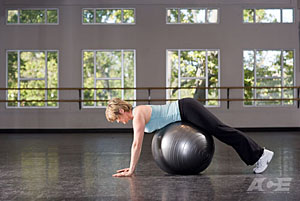
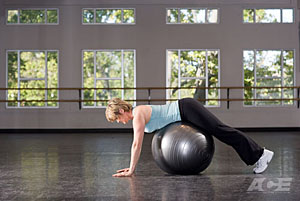
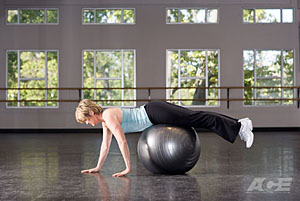
Starting Position: Begin in an all-fours position with your torso on the ball and hands and feet on the floor. Lengthen your legs and stretch your heels to the back of the room. Your hands should be under your shoulders.
Take a few deep breaths. Notice how your abdominals want to rest on the ball when you inhale.
Exhale and pull your abdominals away from the ball. Try to keep them pulled away even when you inhale. This is your abdominal engagement. Try to maintain this engagement throughout the exercise.

Step 2

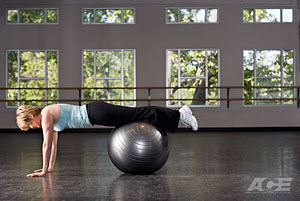
Upward Phase: Gently exhale. With your abdominals engaged, slowly walk yourself forward until your hips lie directly over the top of the ball. With your feet together, lift your legs off the floor until they are in line with your torso. In this position, your body weight is distributed over the ball and supported by both hands placed on the floor. Press and hold your legs together so they move at the same time.

Step 3

Lowering Phase: Inhale. Keeping your legs pressed together, and slowly lower both legs back to the floor. Knees should be straight throughout the movement.
Do not bring your legs above parallel with the torso. This will cause your low back to arch.

readmore »
0
Stability Ball Push-Up |

Step 1

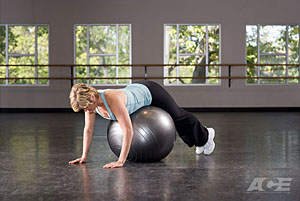
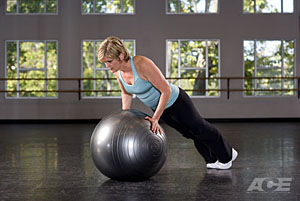
Starting Position: Begin in an all-fours position with your torso on the ball and hands and feet on the floor. Lengthen your legs and stretch your heels to the back of the room. Your hands should be under your shoulders.
Take a few deep breaths. Notice how your abdominals want to rest on the ball when you inhale.
Exhale and pull your abdominals away from the ball. Try to keep them pulled away even when you inhale. This is your abdominal engagement.

Step 2

Slowly walk yourself backwards until your stomach lies directly over the top of the ball with both legs extended and both feet firmly placed on the floor, hip-width apart or wider.

Step 3

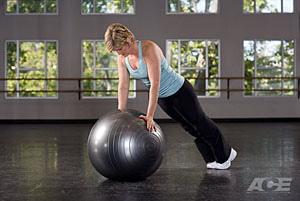
Place your hands on the ball, directly under your shoulders with your elbows pointed toward your ankles. Try to squeeze the ball between your hands to create more strength and stability.

Step 4

Upward Phase: Exhale and slowly press your body upward until your elbows are straight, but not locked. Keep your head, torso and leg straight, strong and aligned with one another. Hold this position briefly.

Step 5

Downward Phase: Inhale and gently lower yourself to start position.

Step 6

Exercise Variation (1): If maintaining stability and pressing up is too challenging in this position, do the exercise in a kneeling position. Remember to keep your head, torso and thighs aligned throughout the exercise.

Step 7

Exercise Variation (2): To increase the balance challenge, this exercise can be performed by bringing your feet together behind you and raising one foot off the floor.
Do not allow the low back to sag toward the floor. Your torso and hips should remain rigid and in parallel throughout the exercise.

readmore »
0
Stability Ball Pikes |


Step 1


Starting Position: Begin in an all-fours position with your torso on the ball and hands and feet on the floor. Lengthen your legs and stretch your heels to the back of the room. Your hands should be under your shoulders.
Take a few deep breaths. Notice how your abdominals want to rest on the ball when you inhale.
Exhale and pull your abdominals away from the ball. Try to keep them pulled away even when you inhale. This is your abdominal engagement.

Step 2

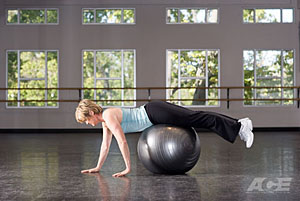
Once you have established your abdominal engagement, slowly walk your hands forward until your feet come off the floor. Continue walking out until the fronts of your thighs or knees are resting on the top of the ball in a plank position.
It is important to keep your ribcage knitted together and the abdominals strong in order to maintain a rigid torso. Your legs should be very active so that your entire body is straight as a board and aligned parallel to the floor.
Keep your shoulder blades pulling away from your shoulders and toward your hips. Elbows must be straight and hands directly under your shoulders. Keep your legs active.

Step 3

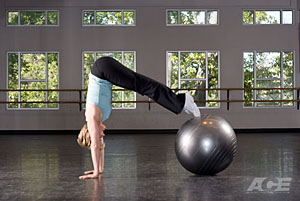
Curling Phase: Exhale. Keeping your legs straight and strong, pull your feet toward your chest. The ball will roll forward as your hips pike upward toward the ceiling. Continue this movement until your hips are directly over your shoulders. Your legs, torso and arms should all be straight and strong. Keep your neck long; your head between your arms. Your can point your toes but always keep your toes connected to the top of the ball.
NOTE: This brings your body into somewhat of a handstand position. Be aware of your shoulder strength and keep the elbows straight.

Step 4

Lowering Phase: Inhale and slowly lower yourself back towards the floor, returning your body to the starting position.
Avoid arching (sagging) your lower back or hiking your hips upwards in the starting position. Contract your abdominal, back and glute muscles to keep your torso and legs parallel to the floor.


readmore »
0
Stability Ball Knee Tucks | Step 1

Step 2

Step 3
Step 4


Step 1

Starting Position:
Begin in an all-fours position with your torso on the ball and hands and feet on the floor. Lengthen your legs and stretch your heels to the back of the room. Your hands should be under your shoulders.
Take a few deep breaths. Notice how your abdominals want to rest on the ball when you inhale.
Exhale and pull your abdominals away from the ball. Try to keep them pulled away even when you inhale. This is your abdominal engagement.

Step 2

Once you have established your abdominal engagement, slowly walk your hands forward until your feet come off the floor. Continue walking out until the fronts of your thighs or knees are resting on the top of the ball in a plank position.
It is important to keep your ribcage knitted together and the abdominals strong in order to maintain a rigid torso. Your legs should be very active so that your entire body is straight as a board and aligned parallel to the floor.
Keep your shoulder blades pulling away from your shoulders and toward your hips. Elbows must be straight and hands directly under your shoulders. Keep your legs active.

Step 3

Curling Phase: Exhale and slowly bend your knees towards your chest. The ball will roll forward as your knees tuck under your torso and your hips lift toward the ceiling.
NOTE: This brings your body into somewhat of a handstand position. Be aware of your shoulder strength and keep the elbows straight.
Ideally, your knees are under your hips, your hips are toward the ceiling and your shins are on top of the ball. Hold this position for a breath.

Step 4

Lowering Phase: Inhale and straighten your legs, rolling the ball back the plank position.

MODIFICATION: If you are uncomfortable or feeling unsafe with your hips raised and shins on the ball, simply tuck your knees into your chest without lifting the hips.
readmore »